Young coaches in Brazil can use performance analysis to grow faster by defining clear game questions, collecting simple data with low-cost tools, and turning insights into targeted training. Start with one game model idea, track 3-5 metrics, review weekly, and share findings with staff and players in simple, visual language.
Core Metrics to Prioritize Immediately
- Number and quality of chances created and conceded (not just shots).
- Number of effective presses and presses broken in each third of the pitch.
- Frequency and success rate of your main attacking pattern (e.g., overlaps, third‑man runs).
- Time and passes needed to recover defensive organization after ball loss.
- Forward passes completed between lines and progressive carries per game.
- Duels won in key zones (central corridor and half-spaces in your defensive half).
- Training tasks per week that are directly linked to your latest game findings.
Setting Clear Performance Questions for Your Team
This method suits young coaches who already have a basic game model and want to be more intentional in their development, even without staff or budget. It is not ideal if you rarely watch your own games back, refuse to change training based on evidence, or only care about final score.
Before thinking about any software de análise tática e estatística para treinadores de futebol, start by clarifying what you want to see from your team. Use questions instead of vague wishes; questions guide what you film, tag, and discuss with players.
- Define one offensive game question for the next 3-4 matches, such as “How often do we create a clear finishing situation within 10 seconds after recovering the ball in the middle third?”
- Define one defensive question, for example “How often do we force the opponent to play backwards when we press their buildup?”
- Define one transition or set-piece question, like “How quickly do we recover compactness after losing the ball in the attacking third?”
- Connect each question to a visible behavior, not an abstract idea (e.g., “three players sprint to close central space” instead of “we are aggressive”).
- Limit yourself to 3-5 questions per period; more than that becomes unmanageable when you are a young coach working mostly alone.
If you ever feel stuck choosing questions, look at your last three games and simply ask: “Where are we repeatedly losing control?” That repeated problem is usually the best starting point for your analysis focus.
Collecting Relevant Data with Low-Budget Tools
You do not need expensive systems to start; you need consistency, a smartphone, and a simple structure. Later, when your process is stable, it makes sense to consider a specialized software de análise tática e estatística para treinadores de futebol.
Minimal toolkit for young coaches:
- Basic filming setup:
- Smartphone or simple camera with tripod, placed high and central when possible.
- Enough storage and battery; delete old files regularly or back them up to cloud.
- Free or low-cost video software:
- Desktop: tools that allow slow motion, basic drawing, and adding simple tags.
- Mobile: apps that let you trim clips quickly and export short videos.
- Data recording tools:
- Spreadsheet (Excel, Google Sheets) with tabs for attack, defense, and transitions.
- Color codes (green = good, red = problem) instead of complex statistics.
- Backup and sharing:
- Free cloud storage to organize matches by season, competition, and opponent.
- Private links or messaging groups to share clips with players and staff.
As you grow, you may look for a curso de análise de desempenho no futebol para treinadores iniciantes or even a pós-graduação em análise de desempenho esportivo para jovens treinadores, which usually include recommendations of reliable tools appropriate for different budget levels.
Analyzing Patterns: From Match Events to Player Behaviors
- Organize your raw material. Create a folder with match video, team sheet, and a simple match report (result, system, key notes). This prevents you from getting lost when you review games weeks later and supports safe, structured comparison across matches.
- Tag only what answers your questions. Watch the game focusing on your 3-5 questions. Every time one of these situations happens, pause and quickly tag:
- Minute and half (1st or 2nd).
- Type of event (e.g., press, counterattack, organized attack).
- Outcome (success, partial, failure).
Avoid tagging everything; stay disciplined to keep the process realistic for one coach.
- Create small, focused clip playlists. Group your tags into 3 folders: clear successes, clear problems, and “almost there” actions. Aim for 6-10 clips per topic. This volume is safe for players’ attention and lets you see patterns without drowning in video.
- Identify repeated behaviors, not isolated moments. For each question, write down what you see at least three times across the clips:
- Who is consistently out of position or late?
- Which trigger works or fails (e.g., bad touch, backward pass)?
- What spaces are regularly open or closed?
Focus on behaviors you can actually train, not on random mistakes.
- Summarize in a one-page “Game Insight Sheet”. Use a simple structure:
- 3 bullet points of what supported your game model well.
- 3 bullet points of what damaged your model.
- 3 priority behaviors to improve next week.
Keep it to one page to force clarity and prevent overanalysis.
- Transform numbers into coaching language. If you count presses or chances, immediately translate them into messages like “we pressed late, allowing forward passes between lines” instead of “low pressing efficiency.” This makes it easier to design sessions and communicate with players of different education levels.
Fast-Track Mode for Busy Match Weeks
- Choose 1 key question only (e.g., how we defend crosses) and ignore the rest for that week.
- Watch just 20-30 minutes of the game where this question appears most (for example, last 30 minutes).
- Select 5 good and 5 bad clips; write 3 bullet points of patterns you see.
- Design 1-2 training tasks that directly address these patterns and repeat them twice in the week.
Translating Analysis into Actionable Session Plans
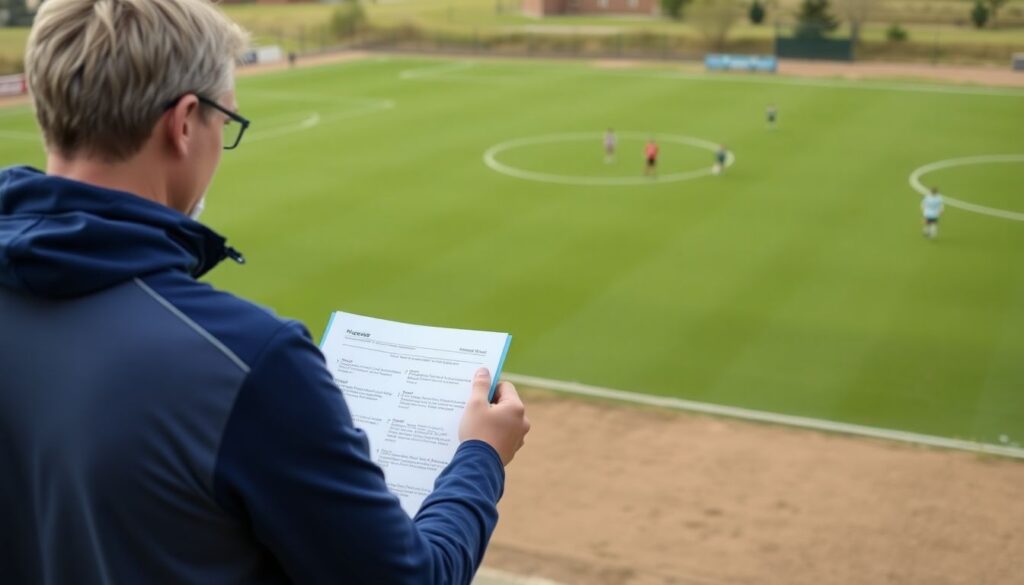
Every insight should turn into a specific change in your training plan. Use this checklist to verify if your session really reflects the analysis.
- Each weekly microcycle includes at least one task per main game question you are tracking.
- Tasks are designed in similar pitch zones, with similar player numbers and directions as the problem you saw in the game.
- Constraints (touch limit, space, scoring rules) encourage the exact behavior you want to change, instead of punishing players randomly.
- You can clearly explain in one sentence how each drill connects to a specific clip or pattern from the last match.
- Coaching points used during the drill copy the language you plan to use in video meetings with players.
- There is built-in measurement inside the drill (e.g., number of successful presses in 10 minutes), not just “play and hope it improves.”
- You repeat key drills across weeks often enough to track progress, instead of changing the entire session design every few days.
- At least one task per week is dedicated to your team’s main strength, not only to correcting problems, so that players feel progress and confidence.
Communicating Insights to Players and Staff Effectively
Good analysis loses value if you communicate it poorly. Avoid these common mistakes when working with players, assistants, or even external support like a consultoria em análise de desempenho para treinadores e equipes de base.
- Showing too many clips in one meeting, which overloads players and hides the main message.
- Using complex statistical terms instead of simple football language adapted to your group’s education level.
- Criticizing individuals publicly without first framing collective responsibilities and structural issues.
- Presenting only problems and no examples of good behavior that you want to reinforce.
- Changing the focus every week, making it impossible for players to know what is truly important.
- Sending clips in random times or channels, instead of a predictable routine (for example, always the day after the match).
- Discussing analysis without linking it to concrete training changes that players will experience on the pitch.
- Ignoring staff input, especially from goalkeeper coach and fitness coach, who often see different perspectives on the same patterns.
Measuring Impact and Iterating Your Coaching Cycle
To accelerate your career, you need to show that your work produces consistent improvements. There are different ways to structure this learning cycle; choose the one that fits your context and time available.
- Minimalist match-to-match loop: After each game, choose one priority, design one main drill, and review the same metric in the next match. Suitable when you coach youth teams with little staff support and limited training time.
- Monthly theme cycle: Focus four to six weeks on a single big theme (e.g., high press, build-up under pressure). Track 3-4 metrics, store them in a simple dashboard, and review at the end of the month. Works well if you combine team coaching with a formação online em análise de desempenho no futebol com certificado.
- Season-long development plan: Map three or four major topics you want to master as a coach (e.g., pressing, positional play, set-pieces, individual development). For each, plan specific learning actions: observing other coaches, taking a curso de análise de desempenho no futebol para treinadores iniciantes, or joining mentoring.
- Partnership with specialists: When possible, complement your work with external analysts or a trusted consultoria em análise de desempenho para treinadores e equipes de base. This is especially useful if you are entering a higher competitive level or doing a pós-graduação em análise de desempenho esportivo para jovens treinadores and want deeper feedback.
Quick Answers to Practical Implementation Hurdles
How many metrics should a young coach track at the same time?
Start with 3-5 core metrics directly linked to your game questions. Tracking more makes your process fragile and time-consuming, especially if you work alone. Add new metrics only after you can reliably collect and use the original ones for several matches.
What if I do not have access to full match video for every game?
Film at least parts of the game that relate to your main questions, such as build-up or defensive block. Shorter but targeted footage is better than no video. Ask parents or staff to help record from a higher point when possible.
How can I use analysis if my players are very young or inexperienced?
Use fewer clips, more demonstrations on the field, and extremely simple language. Show mostly positive examples and recreate the situations in small-sided games. With young players, analysis should feel like a tool for learning, not an exam or punishment.
Do I really need specialized software to progress in my coaching career?
No. You can build strong habits with basic video and spreadsheets. Specialized software becomes useful as your responsibilities grow or when working in professional environments. Focus first on asking good questions and connecting analysis to training and results.
How do I fit analysis work into a busy week schedule?
Use the fast-track mode: pick one key theme per week, review only the relevant part of the game, and create 1-2 focused drills. Block specific time in your calendar for this, even if it is just 60-90 minutes after each match.
How can analysis help me stand out when applying for new coaching opportunities?
Document your process: keep example reports, clip playlists, and before/after metrics. In interviews, show how your analysis led to concrete training changes and performance improvements. Mention any relevant courses or certifications you completed to build credibility.
Is formal education in performance analysis worth it for young coaches?
Yes, if you already apply analysis in practice and want to deepen your understanding. A good formation, like a certified online course or postgraduate program, combined with your own match work, can significantly strengthen your long-term career profile.